
Walk into any gym and you’ll see the same scene on repeat: someone loading another plate onto the bar, reaching for the next size of dumbbells, quietly racing the person on the next rack. Heavier weight has become the unofficial scoreboard of fitness progress.
Progressive overload is real and it matters. But there’s one variable that decides whether a heavier load builds you up or breaks you down — and it’s not strength. It’s exercise form.
That’s where biomechanics comes in: one of the most important and most misunderstood disciplines in exercise science. It governs how efficiently your body moves, how effectively your muscles fire, and how safely you can train at all. Whether the goal is muscle growth, fat loss, athletic performance, injury prevention or a future in coaching, biomechanics is the difference between training that compounds and training that eventually breaks down.
Key takeaways:
- Muscles respond to mechanical tension and movement quality — not the number on the plate
- Poor form shifts stress off target muscles and onto joints, tendons and the spine
- A lighter weight lifted correctly often builds more muscle than a heavier weight lifted poorly
- Biomechanics is the foundation of personal training and coaching
What Is Biomechanics?
Biomechanics is the scientific study of human movement—how muscles, joints, bones, tendons and ligaments work together to produce force and motion. It draws on anatomy, physiology, physics and kinesiology to explain what’s actually happening inside a rep.
It’s also what answers the questions every serious lifter eventually runs into: Why does one squat feel effortless while a nearly identical one wrecks your knees? Why do two people lifting the same weight build muscle at completely different rates? Why does posture that looks ‘fine’ quietly raise injury risk over months of training? Every exercise is a set of forces acting on the body, and biomechanics is the lens that lets a trainer — or a lifter — read those forces before they cause damage.
Why Exercise Form Matters More Than Weight
The biggest misconception in fitness is that heavier weight automatically means better results. It doesn’t. Muscles don’t know what’s printed on the plate — they respond to mechanical tension, range of motion, time under tension and movement quality. That’s the whole equation.
When form breaks down under too much load, the target muscle stops doing most of the work. The stress doesn’t disappear — it redistributes into the joints, tendons, ligaments, lower back, neck, knees and shoulders. That’s the exact combination that raises injury risk and lowers training effectiveness at the same time. Proper technique is what keeps the stimulus where it belongs, so the muscle you intend to train is the one actually doing the work.
Biomechanics and Muscle Activation
Muscle activation describes how effectively a muscle is recruited during a lift. Correct biomechanics improves neuromuscular efficiency, motor recruitment, force production, joint stability and coordination — all at once, in the same rep.
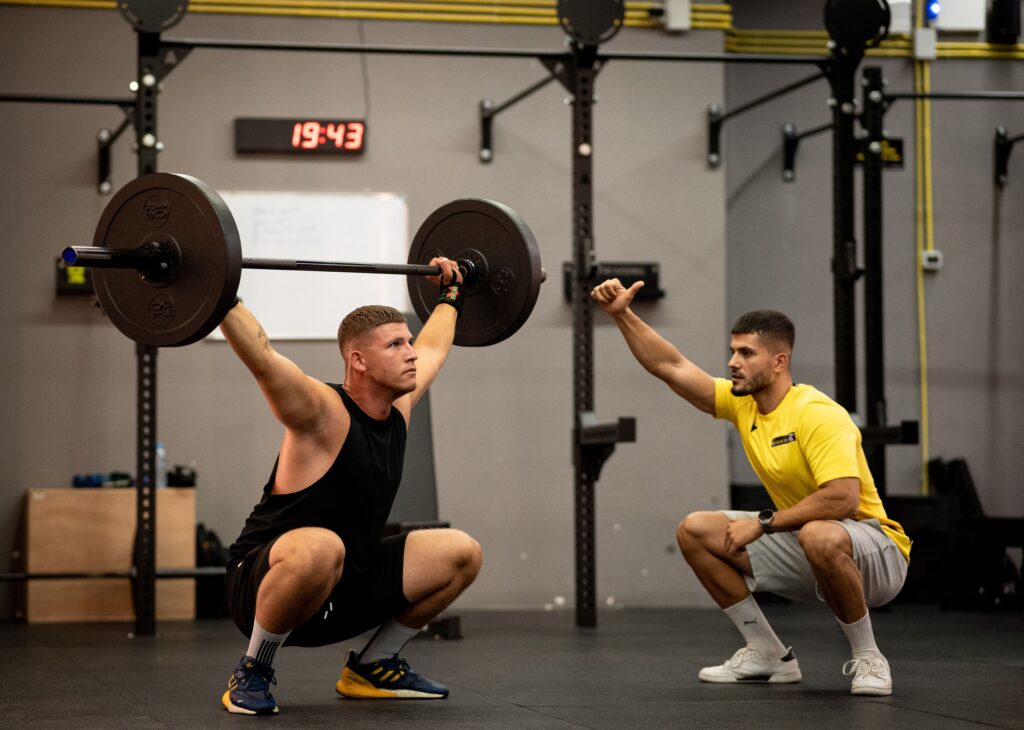
In a squat, proper mechanics activate the quadriceps, glutes, hamstrings and core together. Poor mechanics shift that load toward the knees or lower back instead, so the same exercise produces less muscle growth andmore injury risk. Better movement patterns create better activation. Better activation creates better results. It’s a direct chain, not a coincidence — which is exactly why coaching cues exist in the first place.
The Six Fundamental Movement Patterns
The human body is built around a small set of foundational movement patterns and every well-designed program is structured around them:
| Pattern | Common Exercises |
| Squat | Bodyweight Squat, Goblet Squat, Back Squat, Front Squat |
| Hip Hinge | Deadlift, Romanian Deadlift, Kettlebell Swing |
| Push | Push-up, Bench Press, Overhead Press |
| Pull | Pull-up, Row, Lat Pulldown |
| Rotation | Cable Rotation, Medicine Ball Throw |
| Locomotion | Walking, Running, Sprinting |
Biomechanics is what lets a coach optimize each pattern for the person in front of them, instead of applying the same generic cue to every body type.
Common Biomechanical Errors in the Gym
Most gym injuries trace back to poor movement mechanics — not excessive training volume.
Squats: Knees collapsing inward, excessive forward lean, a rounding lower back and limited ankle mobility — all reduce force production while quietly overloading the knees and spine.
Deadlifts: A rounded lumbar spine, a bar drifting away from the body and poor hip-hinge mechanics are the three most common and most dangerous technical breakdowns in the gym.
Bench press: Shoulder discomfort is usually traced to poor scapular positioning, excessive elbow flare or a lack of upper-back stability— all three are fixable with correct biomechanical cueing.
How Poor Form Leads to Injury
Injury rarely comes from a single bad rep. It develops from repeated exposure to a flawed pattern, set after set, week after week.
- Lower back pain is commonly linked to improper deadlift mechanics, poor core stability and excessive spinal flexion.
- Shoulder injuries usually trace back to poor overhead mechanics and weak scapular stabilizers.
- Knee pain is frequently caused by poor squat mechanics and knock-knees, particularly by excessive knee valgus (the knees caving inward).
Good biomechanics distributes force evenly across the body instead of concentrating it on the structures least equipped to absorb it.
Biomechanics and Strength Training
Strength training isn’t just moving weight from point A to point B — it’s producing force efficiently while keeping the joints aligned. Effective biomechanics improves strength development, power output, movement efficiency.and injury resilience together. That’s why athletes who’ve mastered their mechanics regularly outperform stronger athletes who haven’t — a pattern that holds across nearly every sport, not just weightlifting.
Biomechanics and Muscle Growth
Hypertrophy depends on mechanical tension, metabolic stress and progressive overload — and biomechanics directly shapes all three. A properly executed Dumbbell Row keeps tension on the target muscle through the full range of motion. A poorly executed one leans on momentum and loses most of that stimulus halfway through the set.
In practice, that means a lighter weight lifted with control can build more muscle than a heavier weight lifted sloppily. Quality precedes quantity, every time — a principle that’s easy to say and surprisingly hard to practice under a loaded bar.
Why Fitness Professionals Must Understand Biomechanics
A defining trait of a great personal trainer is the ability to see movement — to catch a fault before it becomes an injury, not after. That takes real, structured knowledge of joint actions, muscle function, force production, movement assessment and exercise modification.
This is exactly the foundation a credible personal trainer certification program should be built on. It’s what separates professional coaching from guesswork dressed up as motivation.
Individual Differences Matter
No two people squat, hinge or press identically. Limb length, joint structure, mobility, stability and training history all shape what correct form actually looks like for a given body. Good coaching adapts the exercise to the individual, rather than forcing every client into the same movement template regardless of how their body is built.
How to Improve Your Exercise Form
- Start with lighter loads and master movement quality before adding resistance.
- Train through a full range of motion to build both mobility and muscle activation together.
- Use video analysis — recording your lifts reveals faults you genuinely cannot feel in the moment.
- Work with a certified trainer who can spot inefficiencies early and correct them before they become patterns.
- Prioritize mobility and stability work, since most technique breakdowns start there, not at the muscle.
The Problem With ‘Ego Lifting’
Ego lifting happens when weight is prioritized over technique: excessive momentum, partial reps, poor posture and loss of control through the sticking point. It might look impressive for a rep or two, but it recruits less muscle and carries far more risk of injury than a controlled and properly loaded set. Elite coaches and athletes understand this well — which is exactly why the best lifters in any gym are rarely the loudest ones.
Biomechanics and Long-Term Fitness Success
Fitness isn’t a six-week challenge. It’s a decades-long relationship with your own body. The people who stay strong, mobile, and injury-free well into later life are almost always the ones who prioritized movement quality early, long before it became necessary. Good biomechanics pays that forward — sustainable training, faster recovery, lower injury risk, and a better quality of life for years after any individual workout is forgotten.
The Future of Fitness Education in India
As the fitness industry becomes increasingly popular, biomechanics is shifting
from ‘nice to know’ to a ‘baseline requirement’ for any coach who wants to be taken seriously. Modern trainers are expected to understand exercise science, functional anatomy and biomechanical analysis, not just program templates and motivational cueing.
That shift is exactly what’s shaping the next generation of fitness education in India — and it’s the standard we’re building our academy around from day one, rather than retrofitting it in later.
Final Thoughts
In fitness culture, usually the number on the bar gets the applause. But real, lasting progress is built on movement quality, not ego. Biomechanics is the foundation underneath strength, muscle growth, injury prevention and athletic performance alike. Before chasing a heavier lift, master the technique underneath it—a perfectly executed rep with moderate resistance will almost always out-produce a poorly executed rep with a heavier one.
Your body rewards precision before power. Master the movement, respect the mechanics, and build strength that actually lasts.
Frequently Asked Question
Is exercise form really more important than the amount of weight lifted?
Yes. Muscles respond to mechanical tension and movement quality, not the number on the plate. Poor form shifts stress onto joints and connective tissue and reduces the muscle activation you’re actually training for.
How do I know if my squat or deadlift form is correct?
Common warning signs of an incorrect form include knees caving inward, a rounding lower back, or the bar drifting away from your body mid-lift. Video analysis and a session with a certified trainer are the fastest ways to catch faults you can’t feel from the inside.
Can lighter weights with good form build more muscle than heavy weights with poor form?
Often, yes. Hypertrophy depends on mechanical tension and time under tension — a controlled lighter set frequently activates a target muscle better than a heavier set performed with momentum and compensation.
Why should personal trainers study biomechanics?
Biomechanics gives personal trainers the ability to assess movement, catch compensations early and design safe, effective programs. It’s the scientific foundation behind professional coaching and that’s why biomechanics is core to any credible personal trainer certification.
What’s the difference between mobility and stability in exercise form?
Mobility is the range of motion available at a joint; stability is the ability to control that range under load/tension. Most technique breakdowns come from a deficit in one or the other—which is why both need to be trained, not just strength.